Oily: Every field ticket chased to cash, every leak priced
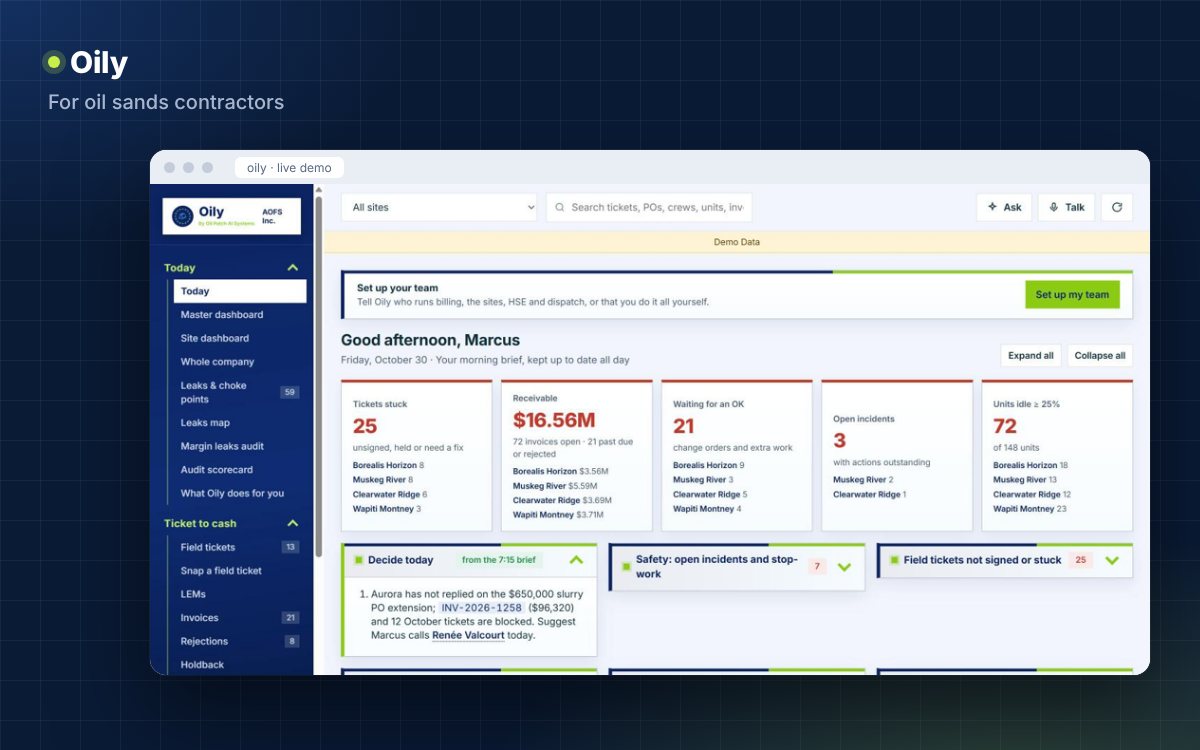
Oily is the ticket-to-cash system we built for oil sands contractors working under operator MSAs. It reads every field ticket, LEM and invoice the day it shows up, checks it against the site’s rules, and shows the owner exactly where money is stuck and what it is costing, site by site.
The Challenge
For most oil sands contractors the work is not the problem. The money is. A crew finishes the job and the ticket gets signed, then it sits in a truck, a binder or someone’s inbox for two weeks. When the invoice finally hits the operator’s portal, it bounces for a missing PO line or a rate that does not match the MSA, and net 30 turns into 90.
Meanwhile payroll still runs every other Friday. Standby goes unbilled, extra work never gets a change order, units sit idle on one site while another rents iron, and holdback stays locked because nobody chased the last signature. Each leak is small on its own. Added up across four sites they are the difference between a good year and a tight one, and nobody has them on one page.
Our Approach
We start where the money starts: the signed ticket. We followed the paperwork from the field to the operator’s portal and mapped every hand-off where it waits, gets retyped or gets rejected. Then we priced each one in dollars and days, so the fix list ranks itself.
Oily is built inside the tools the contractor already runs, Microsoft 365 for mail and files and the sheets the office already keeps, with n8n moving the work and Claude reading the paperwork. Crews do not get a new app. They text, email or snap a photo of the ticket like they do today, and Oily does the rest.
What It Does
Every ticket checked on arrival
Tickets, LEMs and invoices that come in by email, text, WhatsApp or a photo from the truck are read, checked against that site’s MSA rules and logged before they go anywhere near billing.
Chasers that never forget
Twice a day Oily chases unsigned tickets with the owner reps, groups portal rejections by root cause, runs the payment clock, watches for short-pays and tracks holdback that is still locked.
Leaks and choke points, ranked
A master dashboard ranks every leak by dollars at stake and days lost, by site, so the owner pulls the biggest lever first instead of the loudest one.
A morning brief for every role
At 7:15 each person gets a one-line verdict, up to three decisions ranked by dollars at risk with safety first, and what Oily handled overnight. In the evening, a short lights-out report.
Ask, talk or listen
Ask a question in plain English, talk to it from the truck, or have the brief read out loud on the drive in.
What It’s Built to Change
Oily is built to shorten the time from signed ticket to cash in the bank, cut the rejection rate on the operator’s portal, and get standby, extras and idle iron billed instead of written off.
Just as important, it gives the owner one honest picture of the business every morning, so the conversation shifts from “where is that ticket?” to “which lever do we pull this week?”
Why This Matters
Contractors under operator MSAs do not lose money on the big things. They lose it in the gaps between the field and the office, in paperwork that waits on one person and one inbox.
Oily closes those gaps without asking crews to change how they work, and it puts a dollar figure on every leak so the owner knows which one to plug first.
The company in this build is invented so we can show the whole system working end to end. Every name and number in the demo is made up.
Find your leaks. Then plug them.
Start with the audit. We find what’s choking your growth and what’s bleeding your margin, put a dollar figure on each, then build the fix that pays back first.